What is coinsurance?

Coinsurance: How it works
If you have a health plan, you’ve probably heard the term “coinsurance” at one point or another. Maybe you’ve even wondered what it means or how it works. Let’s take a look at how paying your bill works when you have a health insurance plan with coinsurance:
- First, meet your deductible. Some covered health care services require you to meet your deductible, a set amount of money you pay before your health plan pays for medical costs. Coinsurance and copays usually don’t count towards your deductible.
- Then, pay your coinsurance. After you meet your deductible, you pay coinsurance, a set percentage of the remaining costs of the covered health service.
- Your health plan pays the remaining balance. Once you reach your deductible and pay the coinsurance for a covered service, your health plan covers the rest of your in-network services.
- Reach your out-of-pocket maximum. Remember, your deductible, copays and coinsurance payments count towards your out-of-pocket maximum.
- All covered services are paid in full. If you meet your out-of-pocket maximum, your health plan will pay for 100 percent of covered services going forward.
Copays vs. coinsurance
Some health plans have both copays and coinsurance, meaning they are commonly confused. Let’s take a look at what makes them different.
A copay:
- Is a set amount. A copay is a set amount you pay for a specific service, such as $25 for a primary care provider (PCP) visit.
- Is paid at the time of service. Copays are due at the time you receive the service. If you don’t pay your copay at the time of service, your provider will send a bill.
- Does not count toward the deductible. Copays don’t typically count toward your plan’s deductible, but they do count toward the out-of-pocket maximum.
On the other hand, coinsurance:
- Is a percentage. Your coinsurance rate is the percentage you pay for covered services until you meet your out-of-pocket maximum. Coinsurance percentages vary by plan.
- Is paid only after the deductible is met. With coinsurance, you pay for 100 percent of your health care services until your deductible is met. Then you begin paying coinsurance. Like a copay, coinsurance counts toward the out-of-pocket maximum.
Have questions about health insurance?
If you’re looking to learn more about health insurance, such as commonly used terms and how to make the most of your benefits, Wellmark can help. We’ll explain the basics and connect you to the right resources.
Coinsurance in action
To better understand coinsurance, let’s look at an example. Copay, coinsurance and deductible rates are dependent on the plan. So, let’s say you need a surgery that costs $10,000 and your health plan has a $200 copay, 20 percent coinsurance rate, $1,000 deductible and $6,000 out-of-pocket maximum. This is how the payment would be broken down.
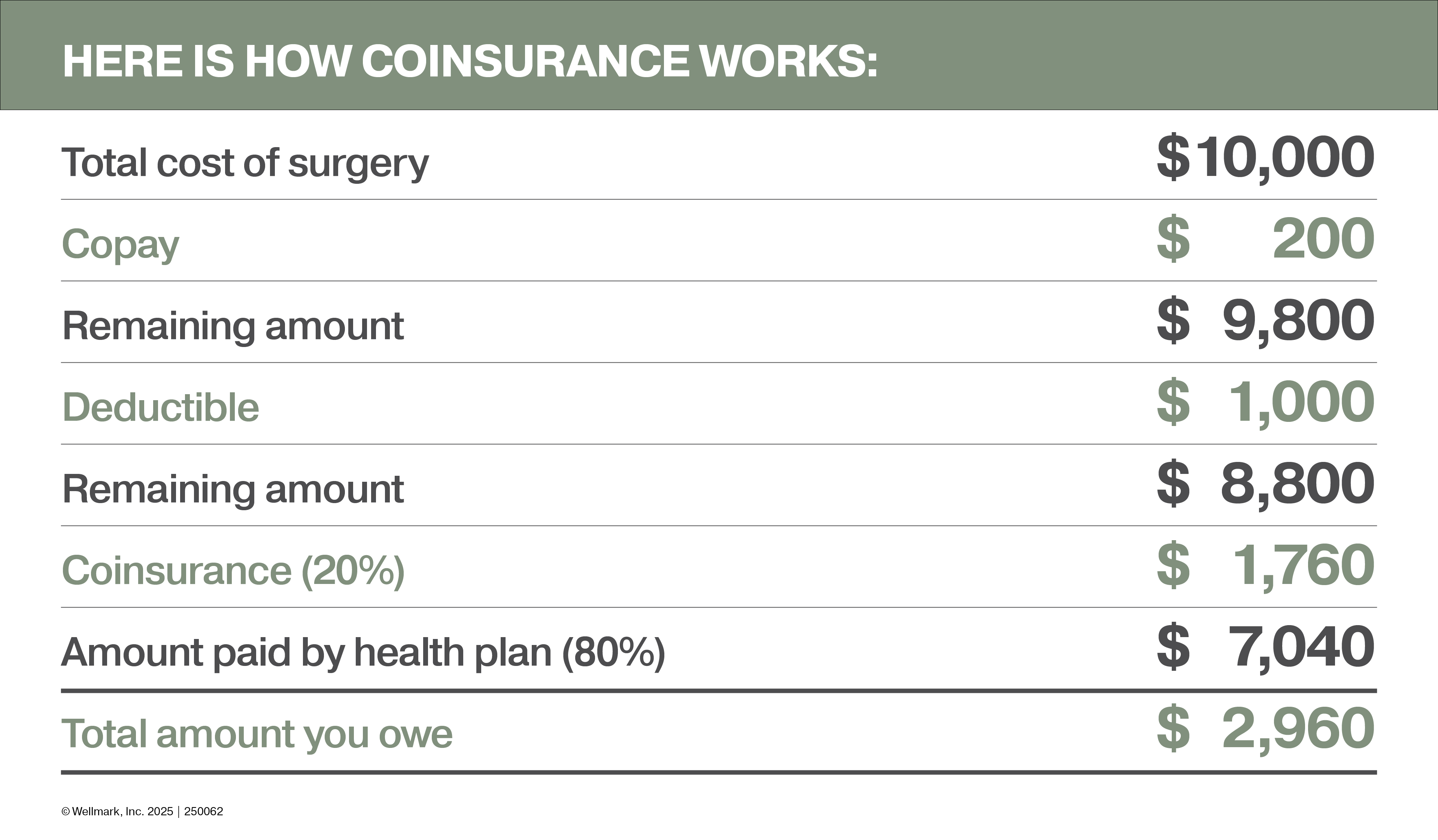
An infographic titled "Here Is How Coinsurance Works" illustrates the breakdown of medical expenses for a surgery costing $10,000. The chart shows a $200 copay, reducing the remaining balance to $9,800. A $1,000 deductible is then applied, leaving $8,800. The patient pays 20% coinsurance on the remaining amount, which equals $1,760, while the health plan pays 80%, or $7,040. The final line highlights the total amount the patient owes: $2,960. The information is displayed in a simple table format with green and gray text on a light background.
In this example, you would pay your $200 copay, $1,000 deductible and 20 percent of the remaining procedure cost, $1,760. This brings the total amount you owe – your out-of-pocket cost – to $2,960 for this procedure. Then the insurance company would cover the remaining $7,040 cost.
Learn more about health insurance
Coinsurance is just one of many terms you’ll want to understand to have a good grasp on the health insurance basics. There’s much more to understanding health insurance, like what an Explanation of Benefits (EOB) is and how to read it, the different parts of Medicare and even surprising benefits your health plan may offer.
If you’re looking for even more content after that, check out the Plan Smart section of Blue for educational health care resources and tips for making the most of your benefits.