How to read your Explanation of benefits (EOB)

Imagine yourself in this situation: You recently had medical care. Maybe it was some blood work or a minor procedure done at your doctor's office. You know your provider has your health insurance ID card on file, but you're not sure how your benefits were applied or if you owe your provider anything for the service.
Lucky for you, you'll soon receive your Explanation of Benefits (EOB). Don't worry — it's not a bill. An EOB is a tool that shows what and how your insurance paid for your care. Your EOB can help you understand how much your provider charged for your care, what Wellmark paid and if you still owe any amount for the service.
See your EOBs in myWellmark®
Log in to myWellmark to quickly view your EOBs whenever it’s convenient for you. You can review claim details, track what’s been processed and keep everything organized in one secure place — no more waiting for paper copies.
Why did Wellmark send me an Explanation of Benefits?
EOBs not only provide detailed information on how your benefits apply to various medical services, but they can also help you understand your total cost of care and spot potential errors before you pay any medical bills.
Here's what you need to know about reading an EOB and how it can help you understand your benefits.
How to read your EOB: an example
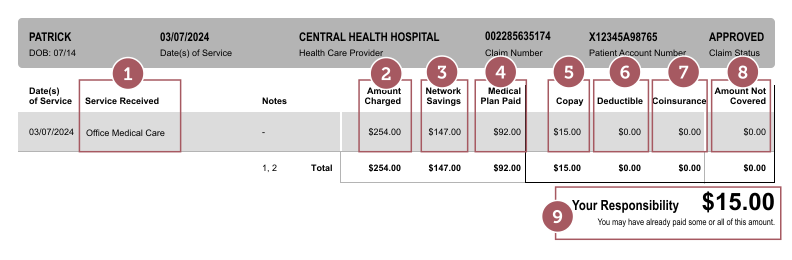
Infographic showing an Explanation of Benefits (EOB) sample with numbered callouts identifying key sections, including the service received, amount charged, network savings, medical plan payment, copay, deductible, coinsurance, amount not covered, and the member’s financial responsibility.
We've made it easy to understand. Let's break down an EOB section-by-section:
1.
Service(s) received
This is a list of the services you recently received from your health care provider. You may not see all services in the same EOB, or you may get more than one EOB if you received multiple services from different providers during a single visit or if you received services on different days.
Why this section matters: When you receive your EOB, you’ll want to make sure the services listed are the correct number and type of services you received. This helps ensure the rest of your EOB is accurate, and you will be billed according to your benefits.
2.
Amount charged
This is the total amount your health care provider charged for the services you received. These amounts will be listed regardless of whether the services are covered under your health plan or not.
Why this section matters: This amount gives you a starting point for understanding the total cost of your care before any health plan discounts or payments are applied. Comparing this number to the amount your plan paid and what you owe can help you see how your benefits helped reduce your costs.
3.
Network savings
This number is the amount you saved by receiving services from an in-network health care provider.
Why this section matters: Seeing your network savings can help you understand the value of using in-network providers. These savings reduce what you pay out-of-pocket.
4.
Medical plan paid
This is the amount your health plan (Wellmark) paid towards your service.
Why this section matters: Comparing what Wellmark paid to the total cost of the service can help you see what portion of the claim may be applied to your deductible, coinsurance or other out-of-pocket costs.
5.
Copay
This is the fixed dollar amount you pay for certain covered services. In most cases, a health care provider requires you to pay this amount at the time you receive services.
Why this section matters: If you already paid a copay when you received care, this section confirms that your payment was applied correctly. It can also help explain part of what you’ll owe. Your total financial responsibility is also listed on your EOB.
6.
Deductible
The number you see here is what you have paid toward your deductible. A deductible is the amount you pay for covered services before your health plan starts sharing the cost.
Once you meet your deductible, you may still be responsible for copays or coinsurance for covered services. Until then, your provider may bill you for costs that apply to your deductible.
Why this section matters: Tracking your progress towards your deductible helps you understand how close you are to meeting it and how that may affect your future costs.
7.
Coinsurance
This amount shows how much you paid in coinsurance. Coinsurance is a fixed percentage of the cost for certain covered services you’re responsible for paying. If your provider hasn't already collected this amount, it may appear on a future bill.
Why this section matters: Reviewing this section can help you plan for future bills and better understand how costs are divided between you and your health plan.
8.
Amount not covered
This section reflects the portion of the charges not covered under your health plan.
Why this section matters: If you weren't expecting these charges, review your coverage documents and discuss the charges with your provider.
9.
Your responsibility
This amount is the portion of the costs you are responsible for paying for the services you received.
Why this section matters: While your EOB isn't a bill, this amount helps you estimate what your provider will bill you for. When you receive the provider's bill, compare this number with the amount listed on your bill.
How will I get my EOB?
It will come in the mail or be delivered digitally.
Digital EOBs get you quick access to the information you need, when you need it. Instead of waiting for a physical copy to arrive in the mail, you'll get a notice delivered to your inbox when you have a new EOB to review.
Here’s how to request digital EOBs:
- Log in to your myWellmark account. Ensure you are in preferences under account.
- In the Explanation of Benefits section, select your preference for receiving your EOBs, including U.S. mail, email or text.
- Select agree & save to finalize these changes.
How long should I keep my EOB?
Generally, you should hang on to your EOB until you can match it up with a bill from your provider's office, which may take anywhere from several weeks to a few months. Your EOBs are also securely stored in myWellmark for up to 24 months.
What do I need to do with my EOB?
Because your EOB is not a bill, you don't need to pay anything when you first receive it. If your EOB shows that you are responsible for some of the cost, your health care provider will bill you directly, or you may have already paid in the form of a copay when you received your service.
Once you receive the bill from your provider, compare the charges on the EOB to the charges listed on the bill to confirm that the services and charges listed are correct. When comparing the bill and your EOB, ask yourself:
- Were the services listed actually received?
- Was the provider listed as in-network or out-of-network?
- Does the amount you owe on the provider bill match what appears on the EOB?
What should I do if I see a mistake on my EOB?
If something looks off — like there are incorrect services listed, or you’ve been billed for more than what your EOB suggests — start by talking with your provider. You can also reach out to Wellmark Customer Service with concerns about your EOB, questions about how your benefits were applied, or how you can use your EOB to read your bill. Call the number on the back of your Wellmark ID card. Get more help navigating (and avoiding) surprise bills with the article from BlueSM.