Boost your workout with lateral movement
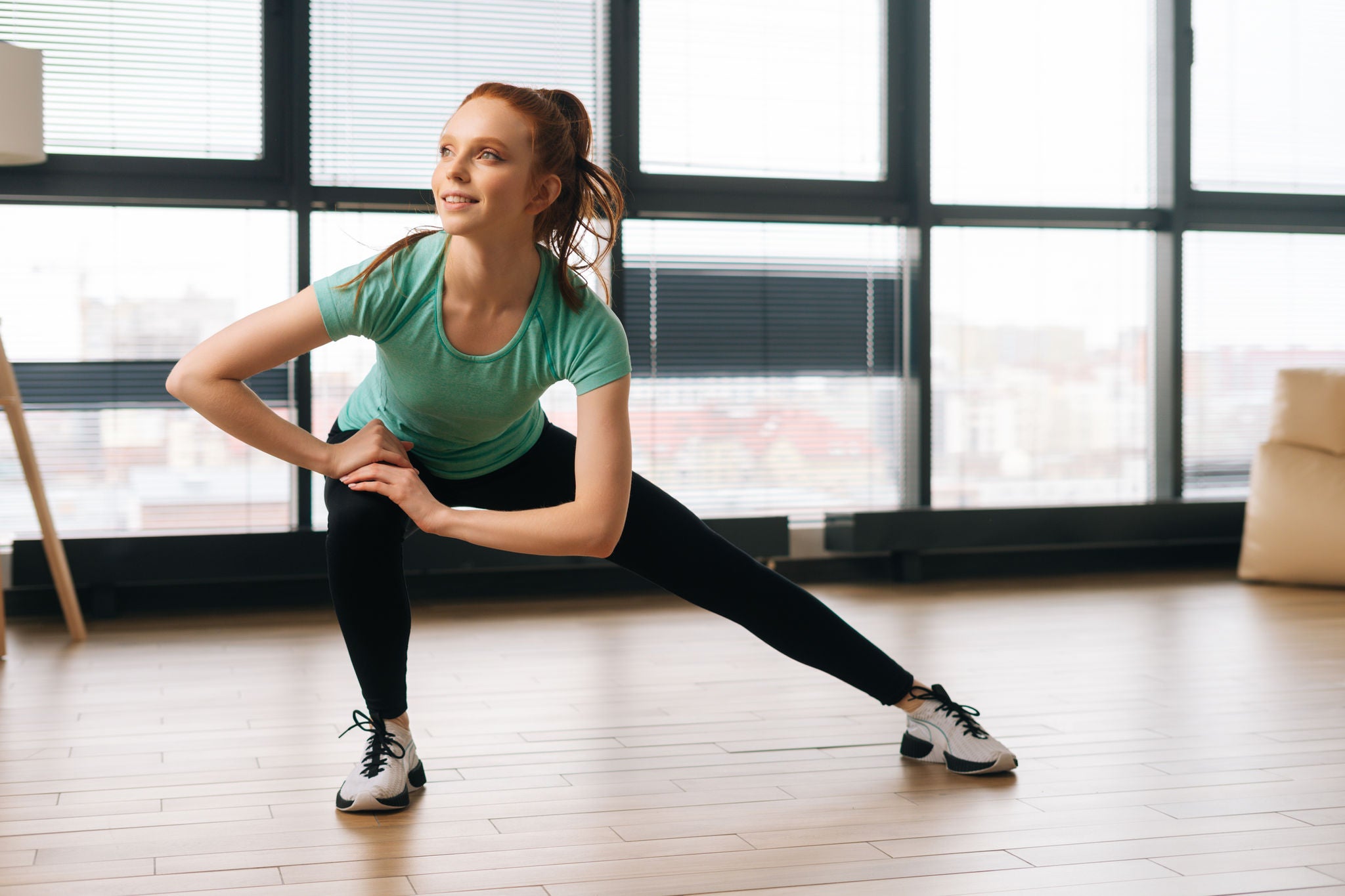
Whether it’s walking, running, going up and down steps, biking or swimming, most of our movement is in one direction — forward. In fact, it may feel strange to move any other way.
However, experts say moving in different planes of motion, such as laterally, can improve your physical fitness. “Side-to-side movements will make you stronger, improve your balance and prevent certain injuries,” says Liza Lichtenberg, an employer health and well-being system specialist at Wellmark Blue Cross and Blue Shield and fitness instructor.
Lateral moves benefit you at any age
“Moving laterally will keep you mobile as you age,” adds Lichtenberg. “That’s because you’ll be working the muscles on the inside and outside of your legs, which help stabilize your hips and pelvis, and that improves your balance.”
It's impossible to avoid lateral movement in daily activities. For example, you might try a new dance move, maneuver to reach something in a tight space or slip on a patch of ice. “Whatever that movement is, if that tissue is weak or tight, you’ll be more at risk for a pulled muscle, hip issues, such as osteoarthritis, or a fall that can cause a serious injury,” says Lichtenberg.
Lateral movements strengthen the body’s supporting muscles and tissues and prevent injuries. Incorporating lateral movement into your exercise regimen can also help your body become faster and increase your stability.
“No matter your age or fitness level, you will see improved performance and quality of life by strengthening those supporting muscles," according to Lichtenberg, “You’ll just be able to move faster and more confidently.”
While it’s important to add lateral movement to your workouts, make sure to do so gradually. Stretching before exercising and giving yourself time to recover after a workout can help prevent injury and make this transition easier. “Muscles and ligaments may be tight at first," said Lichtenberg. "So make sure to warm up properly and go slow. These movements may take a little getting used to.”
Switch up your workout with fitness tips from Blue
From strength training to pickleball, Blue has activity ideas for all fitness levels.
Try these lateral movement strengthening exercises
Target your lower body from every angle possible, and get stronger all over as a result, by adding these side-to-side strengtheners to your warm-up routine or post-workout stretches twice a week.
Side-lunges
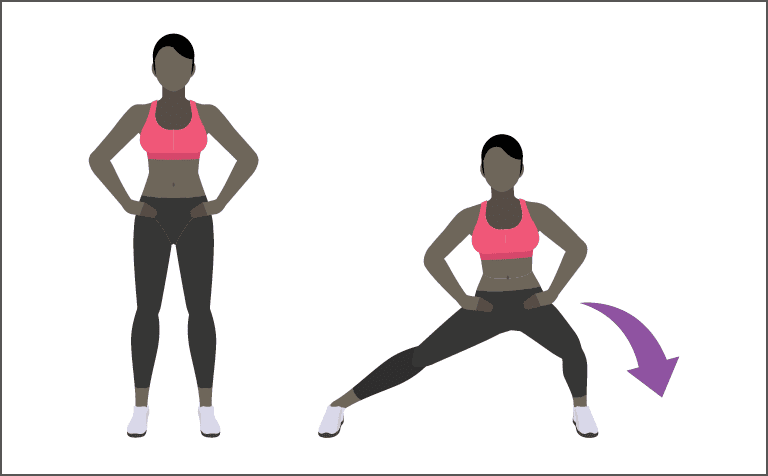
Two side-by-side illustrations demonstrate a side lunge exercise. In the left illustration, a person stands upright with feet hip-width apart and hands resting on the hips. In the right illustration, the person performs a side lunge by stepping one leg out to the side and bending that knee while keeping the opposite leg extended straight. A large curved purple arrow points downward toward the bent knee, indicating the direction of movement. The person wears a bright pink athletic tank top, dark leggings, and white athletic shoes. The images illustrate the starting position and the side-lunge position on a plain light-gray background.
3 sets of 12 repetitions per leg
- Start with your legs slightly wider than shoulder-distance apart with your toes pointed forward.
- Take a large step, lowering into a lunge, until your knee reaches a 90-degree angle and the other leg is straight but not locked, with both feet pointing forward. Sink hips and glutes behind you. Return to center and switch sides.
Side shuffles
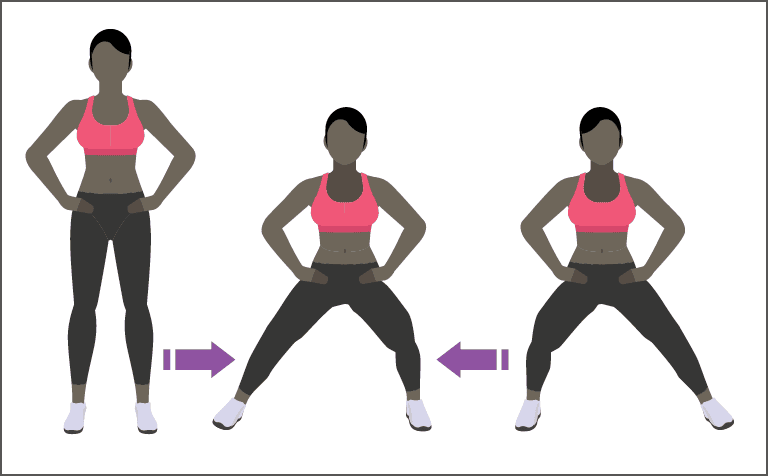
Three illustrations demonstrate a lateral squat, or side-to-side squat, movement. In the first illustration, a person stands upright with feet together and hands resting on the hips. A purple arrow points to the right, indicating a step outward into a wider stance. In the second illustration, the person is shown in a wide squat position with knees bent, feet apart, and hips lowered. A second purple arrow points to the left, indicating movement back toward the starting position. In the third illustration, the person remains in a wide squat stance from the opposite side of the sequence. The person wears a bright pink athletic tank top, dark leggings, and white athletic shoes. The images illustrate stepping out into a wide squat and returning to center on a plain light-gray background.
3 sets for about 20 yards per leg
- Stand with your feet hip-distance apart.
- Hinge at the hips, knees bent, looking forward, chest lifted and with a neutral spine.
- Move to the right using small quick shuffle steps (start small and work your way up), then do the same movement to the left side.
Fire hydrants
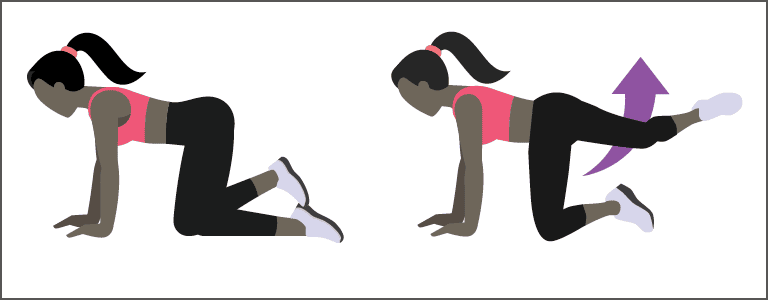
Two side-by-side illustrations demonstrate a quadruped leg raise, or “donkey kick,” exercise. In the left illustration, a person begins on all fours with hands directly under the shoulders and knees under the hips, maintaining a flat back and neutral head position. In the right illustration, the person lifts one leg behind the body with the knee bent at approximately 90 degrees, raising the foot upward until the thigh is nearly parallel to the floor. A curved purple arrow points upward behind the raised leg, indicating the direction of movement. The person wears a bright pink athletic tank top, dark leggings, and white athletic shoes. The images illustrate the starting position and leg-lift phase of the exercise on a plain light-gray background.
3 sets of 10 repetitions per leg
- Start on your hands and knees, with your shoulders above your hands and your hips above your knees. Tighten your core and look down.
- Lift your left leg away from your body at a 45-degree angle. Keep your knee at 90 degrees.
- Lower your leg to your starting position and repeat.
Want some cardio with your lateral moves? Try jumping jacks, star jumps or speed skaters. Another option is to play tennis or pickleball. Both games require lateral moves and will get your blood pumping.
Be responsible with your movement
Be sure to talk to your primary care provider (PCP) before you start a new exercise regimen. And make sure to properly stretch before and after each workout. Introducing lateral movement to your fitness routine is meant to prevent injury — not cause it.