A new day for old-school fitness

“The trend is moving off machines,” says Jordan Evans, health fitness specialist at Wellmark’s Well for Life Center. Some regular gym-goers are tiring of treadmills, elliptical trainers and weight machines. For some, it’s an issue of not getting the results they want. For others, it’s just wanting a change of pace.
Whatever the case, medicine balls are back in play, along with other "throwback" equipment like jump ropes and kettle bells.
Not the medicine balls of years past
The newest medicine balls aren’t necessarily the rock-hard versions you might remember from gym class. Yes, those are still out there, and it’s likely you’ll find those in your gym. Here, we’ll focus on the latest weighted balls, which are bigger and softer and are sometimes called slam or wall balls. They are 14-inches in diameter no matter what weight you select and usually made of synthetic leather.
“I prefer using the latest, soft-type medicine balls,” says Evans. “They don’t bounce back at you. Most importantly, they won’t hit you in the face,” she laughs.
The right medicine ball workout will give you results, while saving you time in the gym.
“In one 20-minute sweat session with this piece of simple equipment, you can get an effective full-body workout,” says Evans. She says many of today’s gym-goers are looking for shorter, more intense workouts. “Many of my clients don’t have an hour to spend in the gym. Or, they are simply getting better results this way.”
Medicine balls provide great intensity, variety and bang for your buck. You don’t need a lot of money or space. You can find them stacked in the corner of your gym. Or, you can purchase one for home use, starting at about $30 each.
In her fitness classes, Evans often incorporates soft-type medicine balls. “Most people wouldn’t know how to use them outside of class,” she says. “The easiest way to use them is by simply walking around with them. You can hug the ball and walk or jog. You can carry it on one shoulder, and for a bigger challenge, you can carry it with both arms overhead.”
Medicine ball workout
Beginners should start with a 10-pound soft-type medicine ball and work up to a 15- to 20-pound medicine ball. Do 15 reps of each exercise, and complete the series three times.
Walking lunge with medicine ball twist
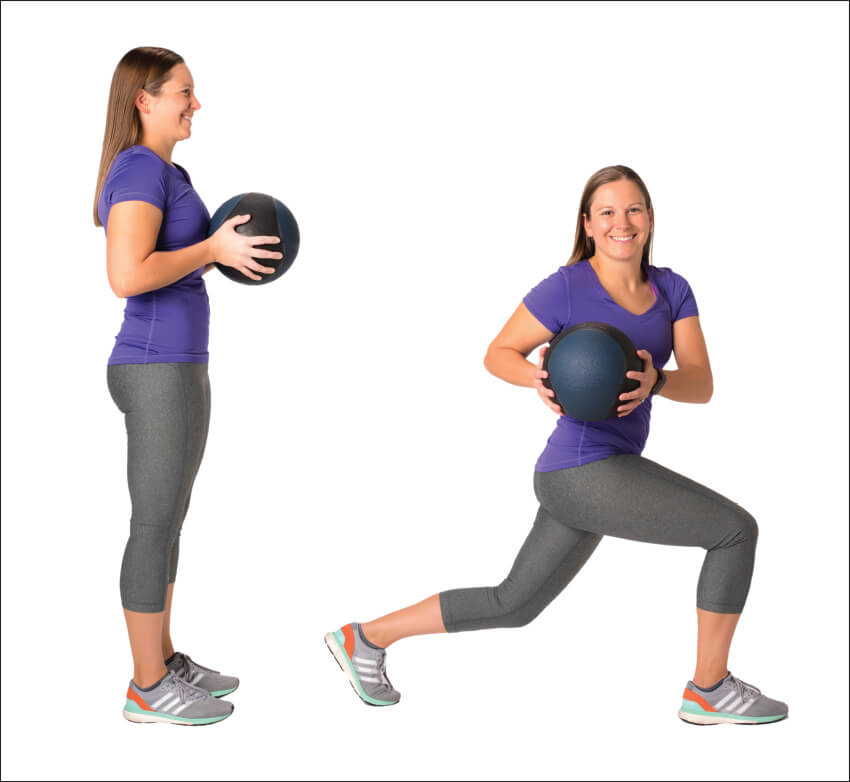
Two side-by-side exercise photos demonstrate a medicine-ball lunge movement. On the left, a person stands upright in profile with feet hip-width apart, holding a dark medicine ball at chest level with both hands. On the right, the person is shown in a forward lunge position, holding the medicine ball at chest height. The front knee is bent approximately 90 degrees and aligned over the front foot, while the back leg extends behind with the knee lowered toward the floor. The person wears a purple short-sleeve shirt, gray capri-length leggings, and athletic shoes. The images illustrate the start and lunge phases of the exercise on a plain light-gray background.
Stand with feet hip-width apart, holding the medicine ball directly in front of you, with a slight bend in the elbows. Step with your right leg forward into a lunge, keeping your thigh parallel to the floor. Twist from your torso over your right leg with the ball. Then step through to a lunge with your left leg and twist left.
Make it harder:
Use a heavier ball, add more reps or move at a faster speed.
Weighted crunch
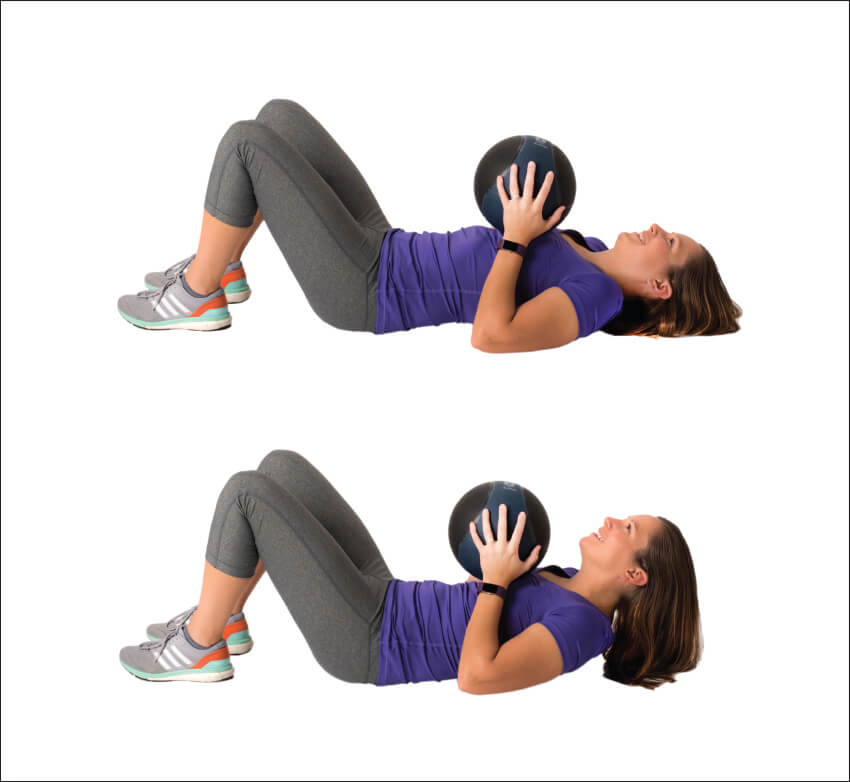
Two stacked photos demonstrate a medicine-ball abdominal crunch exercise. In both images, a person lies on their back with knees bent and feet flat on the floor, holding a dark medicine ball against the chest with both hands. In the top image, the head and shoulders rest on the floor in the starting position. In the bottom image, the head, neck, and shoulders are lifted off the floor in a crunch position while the lower back and hips remain grounded. The person wears a purple short-sleeve shirt, gray capri-length leggings, and athletic shoes. The images illustrate the start and lifted phases of a medicine-ball crunch on a plain light-gray background.
Lie on your back, holding the ball with both hands at chest, knees bent, feet flat on the floor. Lift your body up and forward so your head, neck and shoulder blades lift off the floor. Hold for a moment, then lower slowly back to the floor.
Make it harder:
In a seated position, hold the ball with both hands at chest height, and lift legs off the ground to a 45-degree angle (or as close as possible). Twist from the core and tap the ground with the ball on each side of the body. The faster you twist and the higher you hold your heels off the ground, the more you’ll feel the burn.
Ball slam
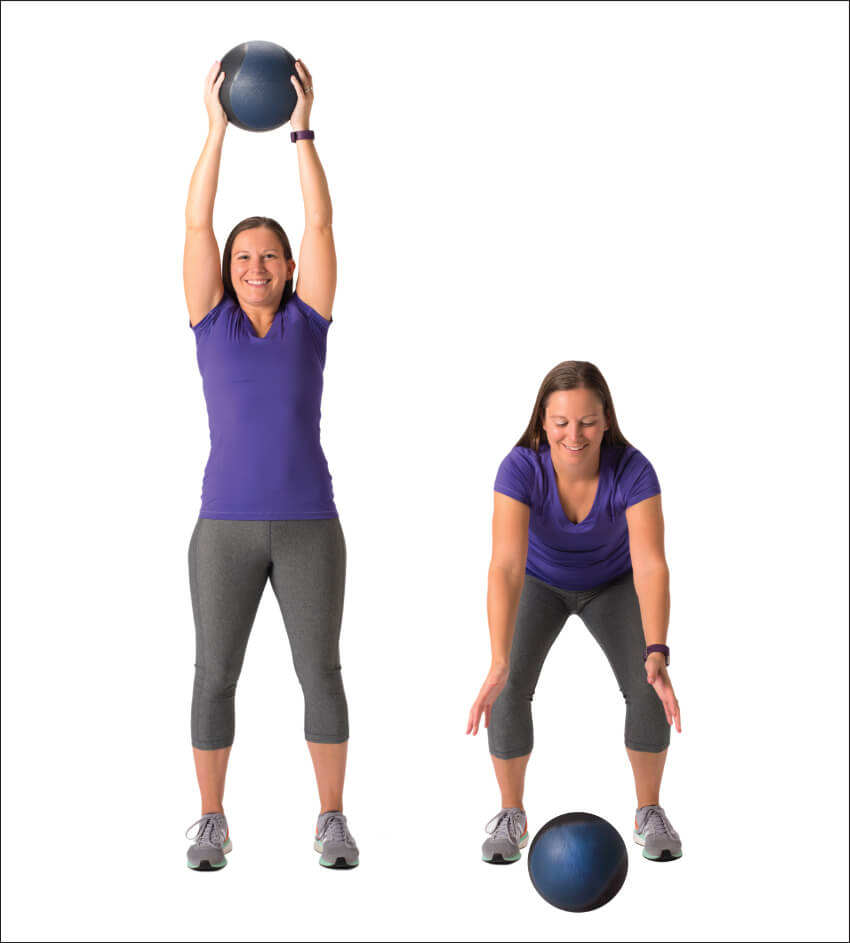
Two side-by-side photos demonstrate a medicine-ball slam exercise. In the left image, a person stands with feet shoulder-width apart, holding a dark medicine ball overhead with both arms fully extended. In the right image, the person is in a partial squat with knees bent and torso hinged forward, releasing or reaching toward the medicine ball as it drops to the floor directly in front of the feet. The person wears a purple short-sleeve shirt, gray capri-length leggings, athletic shoes, and a wristband. The images illustrate the start and downward slam phases of the exercise on a plain light-gray background.
Stand with feet hip-width apart, knees slightly bent. Hold the medicine ball with both hands, and lift it overhead. Bend at the hips, slightly hinging forward, and slam the ball as hard as possible on the ground in front of you. Retrieve the ball and repeat, keeping the core engaged the entire time.
Make it harder:
Add speed, use a heavier ball, add a squat while retrieving the ball or add more reps.
Squat with ball
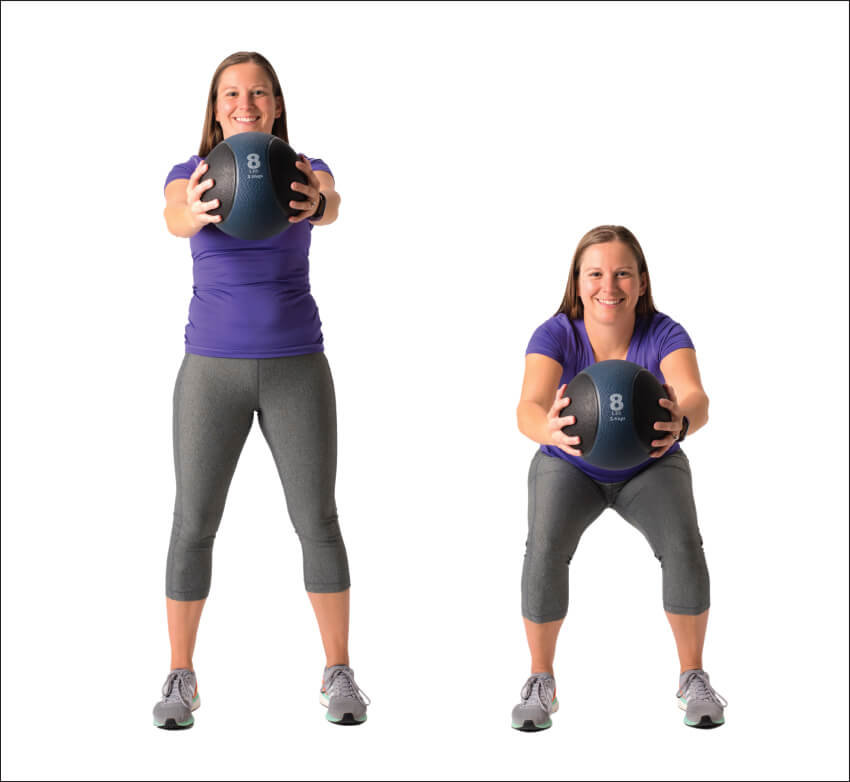
Two side-by-side photos demonstrate a medicine-ball squat exercise. In both images, a person stands facing forward with feet slightly wider than hip-width apart and holds a dark medicine ball with both hands, arms extended straight in front of the body at shoulder height. In the left image, the person is standing upright in the starting position. In the right image, the person lowers into a squat with knees bent, hips pushed back, and chest lifted while maintaining the medicine ball at arm’s length in front of the body. The person wears a purple short-sleeve shirt, gray capri-length leggings, athletic shoes, and a wristband. The images illustrate the start and squat phases of the exercise on a plain light-gray background.
Stand with your feet hip-width apart, toes pointed forward. Hold the medicine ball out in front of your body, slightly above your chest, with arms straight. Do not lock your elbows. Bend your knees, as if you are sitting on a seat behind you, keeping your weight on your heels and your body as straight as possible. Keep your gaze in front of you. Lower yourself as far as you can, not past a 90-degree angle at your knees. Return to upright position.
Make it harder:
Try a squat toss or a wall ball. Hold the ball at chest height, keep your gaze up, lower into squat. Explode up to standing and toss the ball overhead or as high as possible against a wall. Catch the ball and drop back into a squat.
Want to add more challenge to this workout?
Grab a jump rope and jump 50–100 times between each set of exercises.
Save with Blue365®
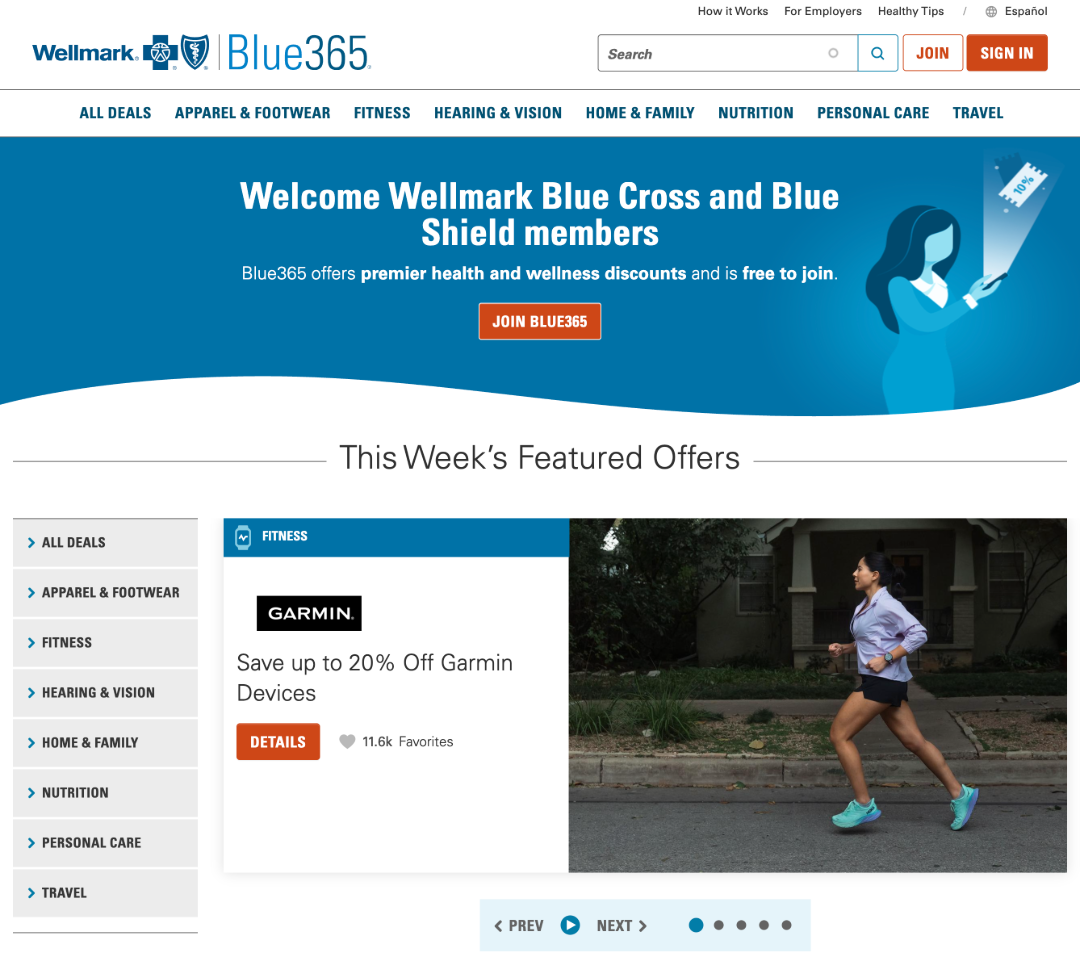
Screenshot of the Wellmark Blue365 discounts website homepage. A header at the top displays the Wellmark Blue Cross and Blue Shield Blue365 logo, navigation links, a search box, and “Join” and “Sign In” buttons. Below, a large blue banner welcomes Wellmark Blue Cross and Blue Shield members, stating that Blue365 offers health and wellness discounts and is free to join, with a “Join Blue365” button. A horizontal navigation menu lists categories including All Deals, Apparel & Footwear, Fitness, Hearing & Vision, Home & Family, Nutrition, Personal Care, and Travel.
The main content area features a section titled “This Week’s Featured Offers.” A highlighted fitness offer advertises “Save up to 20% Off Garmin Devices,” with a Garmin logo, a “Details” button, and a favorites count. Beside the offer is a large promotional photo of a person jogging on a residential street. A vertical category menu appears on the left, and carousel navigation controls are shown below the featured offer section. The page uses a blue, white, and gray color scheme.
As a Wellmark member, you can get exclusive discounts on fitness club memberships, activity tracking devices, fitness apparel and products, and more. Start browsing the healthy deals today and find offers like:
- Save up to 30 percent on fitness tracking devices such as FitBit®, Polar® and Garmin®
- Buy fitness products at a reduced price with retailers such as Reebok®
- Pay less for healthy eating plans like Jenny Craig® and NutriSystem®
Simply use your Wellmark ID card to access Blue365 deals.
Disclosures
Blue365® is a discount program available to members who have medical coverage with Wellmark. This is NOT insurance.
Blue365® is a registered mark of the Blue Cross and Blue Shield Association.